Independent Product Survey
BlueQbit: from technology experiment to focused maritime B2B product
An independent review of BlueQbit’s current concept, structure, usability, functional value, technical maturity and future positioning.
Executive assessment
BlueQbit now has a clear and potentially useful function. Its strongest identity is no longer a generic “AI + blockchain logistics platform.” It is becoming a private B2B maritime and logistics network where professional relationships can move directly from discovery to opportunity, conversation, shipment collaboration and transport agreement.
This is a materially stronger proposition because it describes a concrete operational job rather than a collection of technologies.
1. Concept
The strongest aspect of BlueQbit is the continuity between professional networking and real shipment activity.
- Create a professional profile
- Discover maritime or logistics operators
- Request a business connection
- Share shipment opportunities
- Communicate privately inside the platform
- Express interest in a shipment
- Select an operator
- Confirm a transport agreement
- Retain the operational history
The value is not simply messaging or shipment storage. It is the connection between relationship, opportunity and operational context.
2. The real purpose of the platform
BlueQbit makes the most sense when focused on the relationship between shipper, owner, broker, carrier and maritime operator — and the progression from business connection to shipment opportunity to collaboration to agreement.
Maritime Business Network + Shipment Collaboration Workspace
AI, blockchain, CargoCoin, mapping and routing should support this core workflow rather than define the product.
3. Business Network
The professional network now follows a logical sequence:
Directory → Connect for Business → Accepted Connection → Shared Opportunities → Message
This creates a meaningful business graph rather than a generic contact list. Future value will depend heavily on the quality and verification of members.
4. Shipment Workspace
The Shipment Workspace is becoming one of BlueQbit’s strongest components. A shipment is no longer only a database record; it can become a collaborative operational space containing:
- Shipment ownership
- Network sharing
- Interested operators
- Private communication
- Operator selection
- Transport agreement
- Shipment status
- Operational history
Over time, this could evolve naturally into a logistics deal room with quotations, documents, milestones, participants and audit history.
5. Internal Messaging and Notifications
Moving user-to-user communication inside BlueQbit significantly improved the product. The workflow can now remain:
Notification → Message → Conversation → Shipment
This gives the platform context, continuity and traceability. The notification center also creates a reason for users to return because new messages, connection requests and shared opportunities are surfaced proactively.
6. Usability
The dashboard has improved considerably. Collapsible sections, compact filters and the floating notification center reduce visual overload and make the interface more scalable as historical data increases.
The current information architecture is increasingly clear:
Dashboard → Functional Section → Specific Workspace
As the platform grows, a clearer distinction between Core Operations and Advanced Tools will likely become necessary.
7. AI
AI is potentially valuable, but it should become operational rather than generic. A simple AI chat button is not enough to differentiate a logistics platform.
The stronger direction is contextual AI capable of answering questions such as:
- Which shipments require attention today?
- Which opportunities match my professional profile?
- Summarize my discussion with this carrier.
- What documents are still missing for this shipment?
- Compare the operators interested in this transport.
That would turn AI from a website assistant into an operational assistant.
8. Blockchain and CargoCoin
Blockchain remains an interesting part of BlueQbit, but it should remain optional for ordinary users. Most logistics professionals should be able to create, manage and negotiate a shipment without needing to understand blockchain.
Blockchain can still provide value behind the scenes through timestamping, document hashes, milestones, digital agreements, escrow and verification.
9. Product Positioning
One important finding is that the product has evolved faster than its public positioning. Descriptions such as “AI, Blockchain & Smart Logistics Platform” are now less precise than the product itself.
The newer message — “Connect. Ship. Track. Build business relationships.” — is much closer to what BlueQbit is becoming.
A professional maritime network designed not only to create connections, but to turn those connections into real logistics collaboration.
10. Technical Maturity
BlueQbit is now entering the transition from prototype to product. The platform works, but the codebase still contains evidence of rapid experimentation: duplicated libraries, legacy modules, older Web3 components, outdated references and large HTML files containing substantial CSS and JavaScript.
This is normal for an early-stage platform built iteratively. Future development should increasingly include technical consolidation, modularization and removal of obsolete paths.
11. Trust may become the real competitive advantage
For a maritime B2B network, trust will eventually matter more than additional features.
A profile saying “John Smith — Carrier” has limited value. A profile saying “John Smith — ABC Shipping Ltd — Verified Company — Mediterranean Ro-Ro — 14 completed BlueQbit agreements” has substantially more value.
Verification, reputation, capability, geography and transaction history could become some of the most important assets of the platform.
Overall assessment
| Area | Assessment |
|---|---|
| Core idea | Very promising |
| Internal purpose clarity | Good and improving rapidly |
| External marketing clarity | Needs realignment |
| Professional network | Good foundation |
| Shipment workflow | One of the strongest areas |
| Messaging | Now genuinely useful |
| Notifications | Strong improvement |
| Mobile usability | Good, still refinable |
| AI | High potential, limited operational value today |
| Blockchain / Web3 | Interesting, best kept optional |
| Technical architecture | Functional but needs consolidation |
| Conceptual scalability | Good |
| Current code scalability | Needs improvement before major growth |
| Commercial potential | Exists, dependent on network quality and density |
Final conclusion
BlueQbit should not try to replace LinkedIn as a social network, WhatsApp as a general messaging application or a complete enterprise TMS.
Its opportunity is in the space between them.
Connect → Opportunity → Conversation → Agreement → Shipment History
That is the part of the concept that currently appears most distinctive.
BlueQbit has moved beyond being simply an experimental project. It is becoming an early-stage B2B product with a recognizable purpose and an increasingly coherent workflow.
The next major test is real usage: can 5–10 maritime professionals enter the platform, publish an opportunity, discover an operator, connect, communicate and reach an agreement — and would they choose to use it again?
Product Update · October 2026
Role-Based Maritime Workflow, Blockchain Passport, Optional CargoCoin Escrow and AI-Ready Automation
BlueQbit is evolving into a more structured maritime business ecosystem in which professional roles, operational logic, blockchain verification and optional payment protection can work together without removing human control.
Two distinct professional workspaces
The platform now separates the operational responsibilities of Shippers and Carriers instead of forcing both sides through the same workflow.
Shipper Workspace
- Create shipment requests
- Manage own shipments
- Publish opportunities to the business network
- Review Carrier responses
- Select the Carrier
- Create the Blockchain Shipment Passport
- Confirm final delivery
Carrier Workspace
- View shared transport opportunities
- Express interest in available shipments
- Manage assigned transport jobs
- Confirm cargo Picked Up
- Mark the shipment In Transit
- Declare Delivered
Both roles remain independent while sharing the same BlueQbit business network, private messaging environment, wallet access and blockchain tools.
MetaMask as blockchain identity and signing environment
MetaMask is integrated as a blockchain identity and transaction-signing tool. Login through MetaMask is based on a cryptographic wallet signature and does not require gas. Real blockchain actions, such as deploying a Shipment Passport or interacting with an Escrow smart contract, are different: they are on-chain transactions and therefore require wallet approval and network gas.
The Blockchain Shipment Passport
The Passport is attached to an existing BlueQbit shipment; it does not create a separate shipment. The operational record remains inside BlueQbit, while the Passport provides a blockchain layer that can be linked to the shipment reference, Shipper wallet, Carrier wallet, CargoCoin token, agreed CGC transport amount and deployed contract address.
Private commercial information remains inside BlueQbit. Blockchain is used where it adds practical value: identity, signature, payment protection, transaction verification and immutable history.
Optional CargoCoin Escrow
If the Shipper and Carrier decide to settle the transport in CargoCoin, BlueQbit can make an Escrow smart contract available as a payment-protection mechanism.
Shipper funds CGC → Escrow locks funds → Picked Up → In Transit → Delivered → delivery confirmed by both parties → CGC released to Carrier
The Carrier can know that the agreed funds have been secured, while the Shipper knows that payment cannot be released before the agreed delivery conditions are completed.
If a dispute is opened, the CGC remain frozen inside Escrow. A binding resolution can then execute one of three outcomes: release the funds to the Carrier, refund them to the Shipper, or split the amount between the two parties.
Blockchain and CargoCoin remain optional
This is a central principle of the platform. Blockchain, CargoCoin and Escrow are tools made available by BlueQbit; they are not mandatory conditions for using the network or managing a shipment.
Shippers and Carriers remain free to choose an independent financial settlement method outside BlueQbit if that better reflects their commercial agreement. The purpose of the platform is to provide additional trusted infrastructure, not to force every transaction on-chain.
Preparing the infrastructure for AI-assisted execution
The longer-term objective goes beyond blockchain. As artificial intelligence becomes capable of coordinating more complex operational processes, it will need a structured environment containing clear roles, permissions, commercial conditions, shipment states, payment rules and dispute logic.
BlueQbit is being designed to provide that structure.
Human intention → BlueQbit business logic → AI-assisted execution → verifiable settlement
The human remains the party deciding the intention: who to work with, what service is required, what commercial terms are acceptable, which payment method should be used and what level of automation should be authorised.
Once those intentions are established, more of the repetitive operational and technical steps could progressively be handled automatically. An authorised AI system could eventually coordinate milestones, monitor agreed conditions and execute permitted actions, including payments, when predetermined conditions are fulfilled.
The objective is not to remove human decision-making. It is to prevent growing transport activity from becoming congested by repetitive intermediate decisions and technical actions that can be safely executed by the system.
The direction
BlueQbit is moving toward an ecosystem where humans retain control of commercial intent while software, blockchain and eventually AI handle more of the execution logic around that intent.
This combination can provide a path toward greater operational scale without requiring every shipment to be manually coordinated at every intermediate step.
Development Update · October 2026 · Article 3
From Shipment Workspace to Blockchain Passport: BlueQbit Turns a Transport Agreement into a Verifiable Digital Journey
BlueQbit has reached an important development milestone: the maritime business workflow, role-based shipment management and Ethereum Blockchain Passport now operate as one connected process. The technology stays largely behind the interface; the user follows the shipment.
Start with the shipment, not the blockchain
BlueQbit is being built around a simple principle: maritime professionals should not need to become blockchain specialists to use blockchain verification. The starting point is an ordinary transport requirement.
A Shipper can create and manage a shipment, review its status, share an opportunity with the business network, communicate with operators and select a Carrier. A Carrier works from a different operational perspective: available opportunities and assigned shipments are visible without giving the Carrier the Shipper's creation authority.
This role separation allows the same shipment to be viewed according to responsibility rather than forcing every participant into the same dashboard.
One shipment, several useful views
The shipment can be followed through several connected BlueQbit workspaces. The Shipment view provides the operational record and status. Route & Navigation provides the geographical and voyage context. The Business Network connects the shipment to professional operators and opportunities. Settlement & Escrow shows the agreed commercial revision and whether both parties have confirmed it. Blockchain Passport provides the verification layer. Wallet & Assets provides access to the blockchain identity and transaction environment.
Filters and role-specific lists keep active, pending, in-progress and completed activity manageable as the number of shipments grows. The objective is not to create more screens, but to let each screen answer a different operational question about the same transport.
The agreement becomes the gate
A Blockchain Passport cannot simply be created by one side at any moment. The Shipper and assigned Carrier first confirm the same Settlement Revision. Only when that revision is locked by both parties can the Shipper authorise Passport creation.
Agreement first. Blockchain second.
This matters because the blockchain record should represent an agreed transport relationship, not an unconfirmed proposal.
What is the Blockchain Passport?
In simple terms, the Passport is a digital identity and verifiable history for one shipment. When the Passport is created, Ethereum creates a unique smart-contract address for that transport. BlueQbit receives that address and attaches it automatically to the shipment.
The user does not need to copy contract addresses between systems. The Passport remains connected to the shipment that created it.
Think of it as a digital voyage record that can be independently checked, rather than a replacement for the shipment itself.
Why is it useful?
Traditional shipment information can be distributed across emails, messages, spreadsheets and different company systems. A Blockchain Passport can provide a common verification point for the parties involved in the transport.
- Link a specific shipment to its Shipper and assigned Carrier.
- Give the shipment a unique blockchain identity.
- Provide an independently readable record that is not dependent on one participant's local file.
- Support a future immutable history of transport milestones.
- Create a foundation for documents, delivery evidence and other verifiable events to be linked to the same journey.
- Provide the trusted operational reference required for protected digital settlement.
The blockchain layer is therefore most useful when it stays quiet in the background and answers a practical question: can the parties verify that they are looking at the same shipment history?
Automatic wallet identity
The current workflow also separates the blockchain identities of the two parties. The Carrier registers a public Ethereum wallet to its BlueQbit Carrier profile. When the Shipper authorises a Passport for an assigned shipment, BlueQbit automatically resolves the selected Carrier and retrieves that registered public wallet.
In Wallet Mode, the Shipper connects its own MetaMask account. BlueQbit can therefore prepare the Passport with two distinct parties without requiring the Shipper to manually copy the Carrier's address.
Only public wallet addresses are used by BlueQbit. Private keys and recovery phrases remain inside the user's wallet environment.
Creating the Passport
Passport creation is an Ethereum transaction. It does not transfer the commercial settlement amount: the transaction value is fixed at zero. The Shipper only needs sufficient ETH to pay the Ethereum network fee.
After confirmation, the Factory creates the shipment's smart contract. Its new address is returned to BlueQbit and associated with the shipment automatically. From that point the Passport can be opened and verified in read-only mode without making another transaction simply to inspect it.
From tracking to verifiable tracking
BlueQbit already gives the assigned Carrier control of the physical transport sequence:
Picked Up → In Transit → Delivered
The Shipper then confirms final receipt/completion. These operational actions form the shipment timeline.
The next technical step is to connect those authorised Carrier milestones directly to the Ethereum Passport. The objective is that an operational action in BlueQbit can also become a verifiable blockchain event, creating a permanent journey history without asking the user to manually operate a separate blockchain interface for every update.
What comes next: protected payment through the Escrow Factory
The next major implementation phase is the Escrow Factory for protected settlement. The Passport establishes which shipment, which Shipper, which Carrier and which agreed journey are involved. Escrow can then add the financial layer.
Shipment agreed → Passport created → Escrow funded → Transport performed → Delivery conditions confirmed → Payment released
The purpose is straightforward: the Carrier can know that agreed funds have been secured, while the Shipper can know that release follows the agreed conditions. If a dispute occurs, the protected funds can remain locked until the agreed resolution process determines the outcome.
Blockchain and digital settlement remain tools, not requirements. BlueQbit's objective is to make them available when they add trust and automation while keeping the normal maritime workflow understandable to users who simply want to move cargo.
The broader direction
The development direction is becoming clearer. BlueQbit is not trying to put shipping “on blockchain.” It is building a maritime business and shipment workflow first, then using blockchain selectively where independent verification and protected execution create practical value.
Connect the people. Agree the shipment. Follow the voyage. Verify what matters. Protect the settlement.
That is the role of the Blockchain Passport inside BlueQbit: not another piece of technology for the user to manage, but a trust layer attached to a real transport operation.
User Guide · October 2026 · Article 4
BlueQbit Blockchain Passport: A Simple Guide for Everyday Users
The Blockchain Passport gives each shipment a unique, permanent and verifiable digital identity on Ethereum, while keeping blockchain complexity behind the BlueQbit interface.
What is the Blockchain Passport?
The BlueQbit Blockchain Passport is the digital passport of a shipment. Like a person's passport, it uniquely identifies one specific shipment and creates a permanent reference that can be independently verified.
The Passport is registered on Ethereum and receives a unique smart-contract address. Once created, that address remains linked to the shipment throughout its lifecycle.
The user does not need to understand blockchain technology, search for contract addresses or manually enter technical data. BlueQbit manages those elements automatically.
What is it used for?
The Passport provides a common digital identity connecting the shipment, Shipper, Carrier, agreed Settlement and the future operational history of the transport. It also provides the trusted reference that can later be used by Protected Payment / Escrow.
One shipment → one Passport → one verifiable identity
The Passport is not a payment account. Commercial funds are not deposited into it. Payment remains a separate function handled through the Protected Payment / Escrow system when the parties choose to use it.
Step 1 — Create the shipment
The Shipper creates the transport request normally in BlueQbit, entering the cargo, route and commercial information. No MetaMask connection or blockchain knowledge is required.
Step 2 — Select the Carrier
A Carrier submits a proposal and the Shipper selects the operator that will perform the transport. BlueQbit now knows the two parties to the shipment and their respective roles.
Step 3 — Agree the Settlement
The Shipper defines the commercial settlement terms and the Carrier sees exactly the same revision. Both parties must confirm it. When both have accepted the same terms, the revision becomes Locked by both parties.
If the terms need to change, a new revision is created rather than silently changing an already confirmed agreement.
Step 4 — Passport becomes available
Once the Settlement is locked, BlueQbit shows Ready for Passport. The platform automatically prepares the shipment reference, Shipper wallet, Carrier wallet and settlement asset. The user does not need to copy blockchain addresses.
Step 5 — Create the Passport on Ethereum
The Shipper selects Create Passport on Ethereum. BlueQbit opens MetaMask only for the blockchain authorization.
The Passport creation transaction has a transaction value of 0. This means that creating the Passport does not pay the Carrier, does not move the commercial settlement amount and does not fund the Escrow.
The only amount paid at this stage is the normal Ethereum network gas required to create the contract.
What does Passport creation cost?
BlueQbit does not charge a Passport creation fee. Ethereum itself charges the normal network gas for the on-chain creation transaction.
The gas cost varies according to network conditions. During the first BlueQbit Mainnet end-to-end test, the actual network fee was approximately 0.000079 ETH, about USD 0.20 at that moment.
The gas fee is paid to the Ethereum network, not to BlueQbit.
Step 6 — Passport creation is completed
Ethereum creates a new smart contract dedicated to the shipment. BlueQbit receives the new address and associates it with the shipment. From that moment the workspace displays Passport exists.
The technical address remains available for independent checking, but an ordinary user does not need to work with it manually.
Step 7 — Verify the Passport
The user can select Verify Passport at any time. BlueQbit reads Ethereum directly and checks that smart-contract bytecode exists and that the contract was created through the official BlueQbit Mainnet Factory.
A successful check displays Passport verified on Ethereum Mainnet and BlueQbit Factory provenance confirmed.
Verification is read-only. It does not require MetaMask, does not create a transaction, does not consume gas and has no blockchain cost.
How is the Passport used during the journey?
The Passport accompanies the shipment through its operational lifecycle. BlueQbit can progressively connect milestones such as Shipment Created, Picked Up, In Transit, Arrived at Port, Customs, Out for Delivery and Delivered to the same shipment identity.
The user continues working through the normal BlueQbit workflow. Blockchain should remain behind the interface rather than become an additional operational task.
How is it updated?
Updates originate from normal shipment activity inside BlueQbit. When an event only needs a platform update, no blockchain transaction is required. When an event is intentionally written on Ethereum, the normal Ethereum network gas may apply.
Simple reads, consultation and Passport verification remain free of blockchain transaction costs.
Passport and Settlement
The Settlement records the agreed commercial conditions. The Passport identifies the shipment and provides its verifiable blockchain identity. They are connected but remain different functions.
For example, a shipment can have a commercial transport price of 1,200 EUR and a settlement amount of 100 CgC. The Passport can reference that agreed transport relationship, but it does not hold or transfer those 100 CgC.
Passport and Escrow
After the Passport exists, Protected Payment / Escrow can be prepared separately. The distinction is simple:
Passport = identity and traceability · Escrow = financial protection
The Passport answers which shipment and which parties are involved. Escrow can then protect the agreed payment when the parties choose that settlement method.
What happens at the end of the shipment?
When delivery is completed, the Passport is not deleted. It remains associated with the completed shipment as a permanent blockchain reference.
The Passport does not have a normal expiry date. It continues to exist on Ethereum after the transport is finished.
Does MetaMask need to stay connected?
No. MetaMask is only required when the user must authorize a real blockchain action. Creating the Passport is one such action. Reading or verifying an existing Passport does not require MetaMask.
Do users need to understand Ethereum?
No. BlueQbit is designed so that ordinary maritime users do not need to search contract addresses, copy wallet addresses, understand ABIs, use Etherscan or manually manage smart-contract data.
The blockchain should work behind the platform, not become additional work for the user.
Costs — simple summary
| Action | Blockchain cost |
|---|---|
| Create shipment | None |
| Select Carrier | None |
| Define Settlement | None |
| Confirm Settlement | None |
| Create Blockchain Passport | No BlueQbit Passport fee; normal Ethereum network gas applies |
| Verify Passport | None |
| Consult Passport | None |
| View on Etherscan | None |
| Future events intentionally written on Ethereum | Normal Ethereum gas may apply |
In one sentence
The BlueQbit Blockchain Passport gives a shipment a unique, permanent and verifiable digital identity without requiring users to become blockchain specialists and without mixing shipment identity with commercial payment.
Development Update · October 2026 · Article 5
From Route to Conversation: BlueQbit Becomes an Agent-Ready Maritime Operations Workspace
BlueQbit now connects shipment data, route planning, estimated tracking, marine-weather planning and private business communication in one operational environment — readable by people today and structured for authorised software agents tomorrow.
A shipment can now become a route
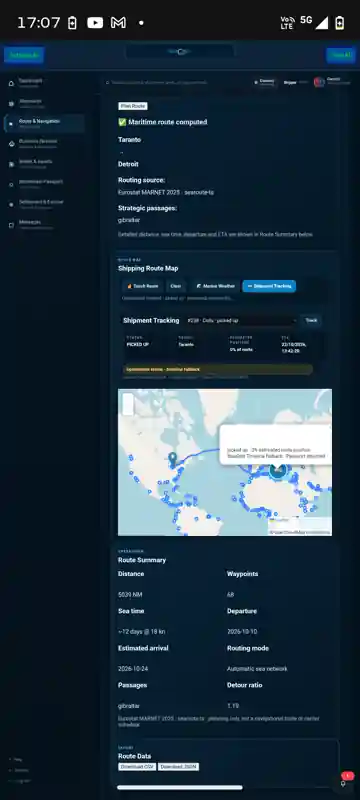
Route & Navigation can be used in two simple ways. A user can enter a route manually, or select an existing BlueQbit shipment. When a shipment is selected, BlueQbit fills the same route-planning fields with the shipment’s origin, destination, departure information and cargo context. The normal route engine then calculates the voyage.
This removes repeated data entry. The shipment becomes the starting point for the route, distance, estimated sea time, estimated arrival, waypoints and important passages.
One real example: Taranto to Detroit
In the current working example, Shipment #238 is selected directly from Shipment Tracking. BlueQbit loads Taranto as the origin and Detroit as the destination, then calculates the maritime route using the same planner that is available for manual use. The workspace shows the distance, estimated sea time, departure date, estimated arrival, route waypoints and strategic passages in one place.
Touch-first planning without making the screen complicated
On a phone or tablet, Touch Route lets the user tap the origin port and then the destination port directly on the map. The map can still be dragged and zoomed normally. Users who prefer the traditional method can continue to use the Origin and Destination fields.
The purpose is not to create a specialist bridge-navigation system. It is to make ordinary commercial voyage planning understandable and quick, including on a mobile device.
Marine weather only when it is needed
Marine Weather is optional. When it is switched on, BlueQbit can show planning information for wind, waves, sea-surface temperature, currents and air temperature along the route. The weather layers are loaded only when requested, so the normal route page stays light and fast.
The weather information is a planning aid. It is not a replacement for official navigation information, bridge systems, pilotage advice or a vessel’s approved weather-routing service.
Tracking that says exactly what it knows
BlueQbit uses the shipment lifecycle to place the cargo on the route. Picked Up places it at the departure port. In Transit can show an estimated position along the voyage. Delivered places it at the destination.
This is deliberately described as an estimated route position, not live AIS or GPS. The status area also explains whether a lifecycle milestone is available as a blockchain-verifiable Passport event or whether BlueQbit is currently using the operational timeline as the source. The platform should never pretend to know a live physical position when it does not.
This distinction is important: Route & Navigation can already turn a shipment status into useful geographical context, while a future live-data source could later replace the estimated position without changing the basic user experience.
Messages is becoming the communication layer around the shipment
BlueQbit Messages now works more like a familiar business messenger. Accepted Business Network connections appear as contacts. Selecting a person opens the conversation. On mobile, the user can move naturally from the contact list into a full conversation and back again.
The paperclip panel adds business context without turning the chat into a complicated management screen. It can show who the contact is, the accepted BlueQbit relationship and shared shipment activity when that context exists.
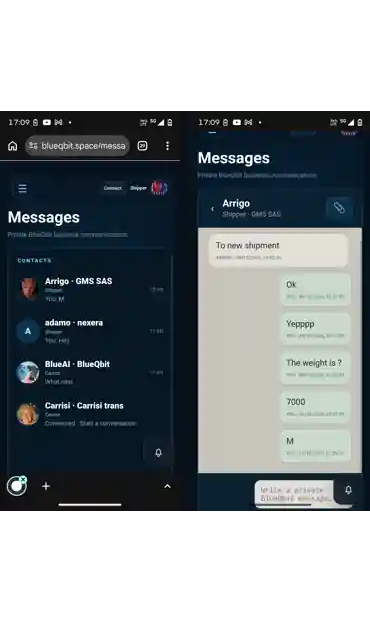
The value is not simply “chat”. The conversation can remain connected to the business relationship that created it: who the parties are, whether they are connected, which shipment they share and what operational work is taking place around that shipment.
Why Route and Messages belong together
The route explains what is happening physically. Messages explains what the people involved are discussing. The shipment connects the two.
Keeping these functions inside the same environment reduces repeated data entry and lost context. A user can move from a transport requirement to a route, from the route to an operational status, and from that status to the person involved without rebuilding the story in a separate application.
One shipment can become the shared reference for route, status, conversation and future authorised action.
Designed for people today — structured for software agents tomorrow
The longer-term direction is not to hide people behind artificial intelligence. It is to make every operation clear enough that either a person or an authorised software agent can understand what is happening.
An AI agent should not have to guess from a screen. It should be able to work from structured facts: the shipment, the parties, the origin and destination, the route, the ETA, the lifecycle status, the conversation context, the permitted actions and, when applicable, settlement, escrow and Passport information.
This is what agent-ready means for BlueQbit. Future AI systems — including more capable AI or AGI systems — could interact with the platform through clear states, roles and permissions instead of trying to imitate a human clicking blindly through pages.
The same structure that makes the platform easier for a person to understand also makes it easier for software to understand. Clear shipment states, clear ownership, clear permissions and clear next actions create a language that both can use.
Human authority remains the boundary
Agent-ready does not mean that an AI should silently change a price, approve a payment or release commercial value. Critical actions still need the permissions and approvals defined by the platform. Automation can remove repetitive work while responsibility remains explicit.
A practical future model is simple: the human defines the transport requirement, commercial intention and level of authority. BlueQbit provides the structured operational environment. An authorised agent can then handle routine coordination inside those boundaries and return to the human when a new decision is required.
Useful infrastructure without forcing a heavy proprietary stack
The current basic route-and-weather experience uses open or freely available data and services where practical. This keeps ordinary planning accessible without requiring a paid proprietary route subscription just to use the core workspace. Some supporting services are external, and blockchain transactions still involve normal network gas whenever information or value is intentionally written on-chain.
The objective is not to claim that every part of shipping can or should be free. It is to make the BlueQbit workflow useful before expensive specialist services are required, while leaving room for professional data sources to be connected later where they add real operational value.
What comes next
The next product articles should follow tested functionality rather than promises. The Scroll workflow will be documented after its full operational test. The Blockchain Passport will receive a further update after its next end-to-end lifecycle test. The same rule applies to future automation: describe what is working, identify what is estimated, and keep future capability clearly separate from current capability.
In one sentence
BlueQbit is becoming a maritime workspace that people can understand today and authorised software agents can operate tomorrow.
Product Update · October 2026 · Article 6
Blueyes: Bringing BlueQbit Into Your Pocket
From maritime communication to shipment visibility, Blueyes extends the BlueQbit ecosystem into a focused mobile experience designed for professionals who need to stay connected while they are moving.
One BlueQbit identity. Two doors.
Blueyes is not a separate network and it is not a miniature copy of the desktop platform. It is the mobile companion to BlueQbit.
The same professional identity can connect the web platform and the mobile application. BlueQbit remains the environment for deeper work and transactions; Blueyes keeps the user connected to the activity that matters while away from the desk.
Why build a separate mobile companion?
One of the easiest mistakes in software development is to assume that a mobile app should contain everything available on desktop. Blueyes was designed around the opposite principle.
A mobile application should reduce friction, not reproduce a desktop workflow on a smaller screen.
Complex operations such as shipment creation, Blockchain Passport actions, settlement, escrow execution and wallet signing remain on the full BlueQbit platform. Blueyes concentrates on the questions a professional is more likely to ask while moving: who needs me, what changed, which shipment are we discussing, where is it going, and what happened while I was away?
Communication with operational context
Shipping communication can easily become fragmented across email, messaging applications and separate operational systems. Blueyes brings BlueQbit conversations into one mobile environment while preserving shipment context around the people involved.
Accepted BlueQbit contacts appear in Messages. A conversation can contain normal text, manual business-document attachments and shipment-related activity associated with that relationship.
The objective is not to replace human communication. It is to make that communication easier to understand later because the business context remains attached to it.
Shipment visibility without unnecessary complexity
When a user is travelling, onboard a vessel, in a port or simply away from a computer, the useful information is often simple: shipment status, origin, destination, Passport attachment, route, distance and indicative sea time.
Blueyes therefore offers a read-only shipment view and map rather than a second route-planning system. The route and position shown are operational planning information and estimated route context, not live AIS or GPS.
Notifications that mean something
Blueyes separates direct conversations from general platform alerts. Messages remain the place for person-to-person communication and contact-related shipment activity. Notifications are reserved for broader BlueQbit events that are not naturally attributable to a specific contact.
This avoids duplicating the same event in several places and keeps the mobile experience understandable.
Escrow awareness without turning the app into a wallet
Settlement and Escrow remain part of the wider BlueQbit web workflow. Blueyes does not provide banking, cryptocurrency exchange or wallet services and it does not ask the user to execute blockchain transactions from the mobile companion.
What it can do is surface relevant operational milestones already produced by the BlueQbit workflow — for example delivery confirmations connected to an Escrow-protected shipment — inside the communication context where the user can understand them.
The mobile user sees the event. The transaction logic remains where it belongs.
The current Blueyes experience
The following visual overview brings together the Blueyes identity and the current product direction across route visibility, secure messaging, real-time alerts, shipment overview, dedicated conversations and Escrow-related milestone awareness.
Designed to complement, not replace, BlueQbit
Blueyes is another way of entering the same ecosystem. On the web, BlueQbit supports the deeper commercial and operational workflow. On mobile, Blueyes provides the immediate layer.
That division is deliberate. It allows the desktop platform to remain capable without forcing the mobile application to become complicated.
Where Blueyes is now
Blueyes has entered its first Android closed-testing phase on Google Play. The current release includes the mobile interface, shared BlueQbit identity, messaging, notifications, shipment visibility and the read-only route view.
This stage is about testing the experience before wider distribution. The objective is not simply to prove that the application opens and functions, but to answer the more important product question: does it make the user's work simpler?
In one sentence
Blueyes keeps maritime professionals connected to BlueQbit while they are away from their desk — without forcing the complexity of the full operational platform onto a phone.
BlueQbit Product Survey · Article 6 · October 2026 · BlueQbit — Connect. Communicate. Move.
Product Update · October 2026 · Article 7
From Fiat to Digital Trust: Making Maritime Transactions Simpler and Safer
BlueQbit connects familiar financial transactions, blockchain tools and verified professional identities within one maritime logistics ecosystem. Our latest work brings these elements together to make the experience clearer, more practical and more trustworthy.
Why connect finance, blockchain and identity?
In international shipping, a transaction begins with people: a Shipper who needs transport and a Carrier who can provide it. Behind every agreement are commercial terms, payment expectations and the need to know who is on the other side.
BlueQbit brings these essential steps into one connected environment, without asking maritime professionals to become blockchain specialists.
From traditional currency to digital settlement
BlueQbit's fiat-to-token conversion experience bridges familiar currency values and token-based settlement. Users can work from agreed commercial amounts, understand the conversion journey and follow the digital transaction within the same platform.
The goal is not to replace a commercial agreement with technical complexity. It is to make digital settlement understandable, while preserving explicit approval of the parties involved.
Blockchain Passport and protected transactions
The Blockchain Passport connects a shipment to a verifiable digital record. Smart contracts and Escrow add a further layer to the agreed settlement workflow: funding, delivery confirmation and release can be represented as clear steps rather than hidden technical operations.
BlueQbit keeps the shipment and its business context at the centre. Blockchain supports the process where it adds value, while people remain responsible for decisions and authorisations.
Stripe Identity: a stronger signal of trust for Carriers
We have also integrated Stripe Identity into the Carrier profile experience. The purpose is simple: before entering a business relationship, a Shipper should be able to distinguish a professional profile from one whose holder has completed personal identity verification.
Carriers follow an identity-check process connected to their BlueQbit account. A verified result is reflected through a clear green ✓ Identity Verified indicator in the Carrier experience and professional directory.
The identity badge confirms personal identity verification; it is not a certification of the Carrier's company, licences, insurance or financial standing.
The professional directory provides an accessible way to discover potential partners while keeping sensitive verification documents out of the public interface.
Human control is the design principle
Technology can make identity signals and payment states easier to understand, but it does not replace the people making the agreement. Shippers and Carriers select partners, accept terms and authorise transactions themselves.
BlueQbit is designed around a simple principle: useful automation should reduce friction without taking commercial authority away from the user.
Blueyes: the mobile companion
These developments sit alongside Blueyes, BlueQbit's mobile companion for messages, notifications and shipment awareness. Blueyes has been completed and is awaiting wider public availability through Google Play.
On the web, BlueQbit supports the full professional workflow. On mobile, Blueyes keeps people connected while they are moving.
Continuing to improve
As with every digital platform, additional user tests and checks help us refine the experience and identify potential bugs. Our focus remains on clarity, reliability and a consistent experience for maritime professionals.
In one sentence
BlueQbit brings traditional finance, blockchain transactions and verified professional identities together in one maritime logistics ecosystem — designed to simplify operations, strengthen trust and keep people in control.
BlueQbit Product Survey · Article 7 · October 2026 · BlueQbit — Connect. Communicate. Move.
BlueQbit Product Survey · October 2026